Wednesday, May 16, 2018

Blood Sampling for Blood Serum Total Protein testing

"When it comes to on-farm calf management, the producer’s main goal is to have healthy, productive calves that will eventually become high-producing cows. To achieve this goal, certain techniques should be used on farm to ensure the calf can reach its full potential. In this issue of The Colostrum Counsel, producers can learn how to assess the quality of colostrum using a Brix refractometer, as well as how to blood sample young calves." I believe much of the content is from an Alta Genetic source.

SCCL publishes the "Colostrum Counsel" periodically - this issue contains picture guides for both refractometer use and blood sampling - very well done. 

Click HERE to go to the Colostrum Counsel publication.

Enjoy

Tuesday, May 15, 2018

Feeding Water to Calves

"Feeding Water to Calves" is the title of the May issue of the calf management newsletter. You may access this issue by clicking HERE or enter this URL in your browser
http://atticacows.com/library/newsletters/CEMay2018.pdf

The key points are: 
  • Water as a nutrient comes in more than one form.
  • But, where does water go inside the calf?
  • Profitable rates of rumen development depend on water.
  • Tips for promoting water intake.
Enjoy.

Tuesday, May 8, 2018

Calves Absorbing Sodium from Electrolytes


In a summary article about calf electrolytes Geof Smith, D.V.M., recently outlined facts about sodium absorption in preweaned calves suffering from diarrhea. 

"The calf must be able to absorb the sodium that you provide. Even in calves that have diarrhea and intestinal damage, there are three major pathways for sodium absoption: glucose, volatile fatty acids (such as acetate or proprionate), and neutral amino acids (such as glycine)."

He points out that you can check your electrolyte label for glycine or acetate.

Of the three electrolytes we stock here at the vet clinic all three contain glycine and one contains both glycine and acetate.

An interesting article, "Keeping Ahead of Calf Diarrhea" by David Rhoda, D.V. M. is available by clicking Hoards-Rhoda or adding this URL to your browser
https://hoards.com/article-1798-keeping-ahead-of-calf-diarrhea-problems.html 
Reference: Geof Smith, "Choosing the right electrolyte." Hoard's Dairyman, April 10, 2018, p219

Monday, May 7, 2018

Requirements for an Effective Electrolyte for Calves

In a summary article about calf electrolytes Geof Smith, D.V.M., recently outlined four requirement for effective electrolytes:
" 1. Supply enough sodium to rehydrate the calf.
2. Provide glycine or acetate to help with the absorption of sodium in the intenstine.
3. Provide an alkalizing agent that wll correct the drop in blood pH (acidosis) that happens when calves develop diarrhea.
4. Provide energy, as most calves with diarrhea are in a state of negative energy balance."

A useful guide on scours (diarrhea) management in calves may be found here Scours - Hoards or use this URL in your browser
https://hoards.com/article-1797-dealing-with-calf-diarrhea.html 

Reference: Geof Smith, "Choosing the right electrolyte." Hoard's Dairyman, April 10, 2018, p219

Friday, May 4, 2018

Temperature of Colostrum

It seems so simple. Feed colostrum at calf body temperature (103F, 30C). 

Why bother with temperature? When the temperature is significantly below calf body temperature the rate of abomasal emptying is depresssed. Cold colostrum sits in the abomasum longer than it should and this lowers the rate of antibody transfer into the blood. Not good. 

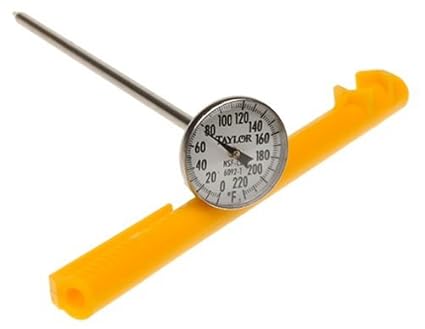
Adding a simple probe-Taylor Precision Products Anti-Microbial Instant Read Thermometer (1-Inch Dial)type rapid-read thermometer to your tool kit (about $6-10) can make monitoring feeding temperature simple.
It' easy - fill nursing bottle with cold colostrum, put on the nipple, stick probe through the vent hole.

If you, like me, has to wear glasses in order to read the dial it may help to use a tag pen to make are mark at 103F so it is easy to read without one's glasses. 


Reference: Mokhber-Dezfooli, M.R. and Others, "Effect of abomasal emptying rate on the apparent efficiency of colostrum immunoglobulin G absorption in neonatal Holstein-Friesian calves." Journal of Dairy Science 95:6740-6749


Thursday, May 3, 2018

Weaning Age and Intensive Milk Feeding Programs

Field experience and research trials have demonstrated the effect of intensive milk feeding programs for dairy replacement heifer calves on the timing of calf starter grain intake. As milk intake goes up the starter grain intake is delayed.

The research reported here looked at delaying weaning of intensively milk fed calves from 60 to 75 days.  The intensive program for calves weaned at 60 days was 4 liters/day on days 3-10, 6 liters/day on days 11-20, 8.5 liters/day on days 21-55, decreased to 4/25 liters/day on days 56-60 (total of 411 liters).

The intensive program for calves weaned at 75 days was 4 liters/day on days 3-10, increased to 6 liters/day on days 11-70, decreased to 3 liters/day on days 71/75 (total 407 liters).

They compared these groups using these measures at 90 days:
Average daily gain
Feed efficiency
Final body weight

The 75-day weaned heifers when compared to the the 60-day weaned heifers were  higher on all three comparison measures.

In my reading of these results I see the advantage of getting more adequate rumen development in the 75-day heifers. This is one of the first studies I can recall that compared feed efficiency. However, few dairies will wait to wean at 75 days. 

A practical alternative would be to modify their 60-day protocol to look like this:
4 L/day on days 3-10
6 L/day on days 11-14
8 L/day on days 15-35
4 L/day on days 36-60

In order to save labor I fed the 4 L/day on days 36-60 once a day, with free choice water and calf starter grain.

My experience with this protocol regarding starter grain intake was initial grain intake greater than 1 cup (110-115g) daily did not start until about 21 days. With high milk feeding the grain intake stayed low until I dropped the milk back to 4 L/d at 36 days - then the calves had a steady upward trend on grain intake until they were eating 4-5 pounds (2-2.25kg) a day by 60 days.

Reference: M. Mirzael and Others, "Effects of preweaning total plane of milk intake and weaning age on intake, growth performance, and blood metabolites of dairy calves." Journal of Dairy Science 101:4212-4220 May 2018

Wednesday, May 2, 2018

Hay for Preweaned Calves

An interesting article in the Irish Farmers Journal, "Dairy Calf to Beef: Rearing Tips," included some advice regarding providing fiber for preweaned calves. 

Recall in this Irish tradition that dairymen have "always" fed straw to preweaned calves. In my experience this traditionally was fed a long straw in a rack in a group pen. 

The initial mention is in the context of housing:

"Calves should be housed on a clean, dry bed of straw and they should have access to a good fibre source like hay or straw and also have access to fresh clean water."

The author concludes:

"Hay and straw. A good fibre source like hay or straw should be made available to calves from three days of age. While feeding hay and straw is important, it's also important not to over consume roughage with a resultant decrease in concentrate intake. 

Chopped forage 3-4cm (1-1.5 inches) in length is ideal. Quality is also important as poor-quality, stemmy material will result in poor intakes and calves not being able to digest it."

[Emphasis added, ed.]

Reference: Wood, Adam "Dairy Calf to Beef: Rearing Tips" Irish Farmers Journal 28April2018 page 40